
Care Gap Closure Flagging for Practices
A Clear Flag, Before The Visit Starts
Care gap closure belongs to your clinical team. My part is quieter: during visit preparation, I flag protocol-based gaps so they show up for your provider instead of living as a sticky note with no last name.
I don’t close gaps, make the clinical decision, or tell a patient to book a test. I look at the record against the rules you give me, plant a clear flag, and step back. Flags are only useful when someone authorized actually reviews them.
I’m Mark, a registered nurse, and these days my shift is all charts.
What The Flag Actually Looks Like
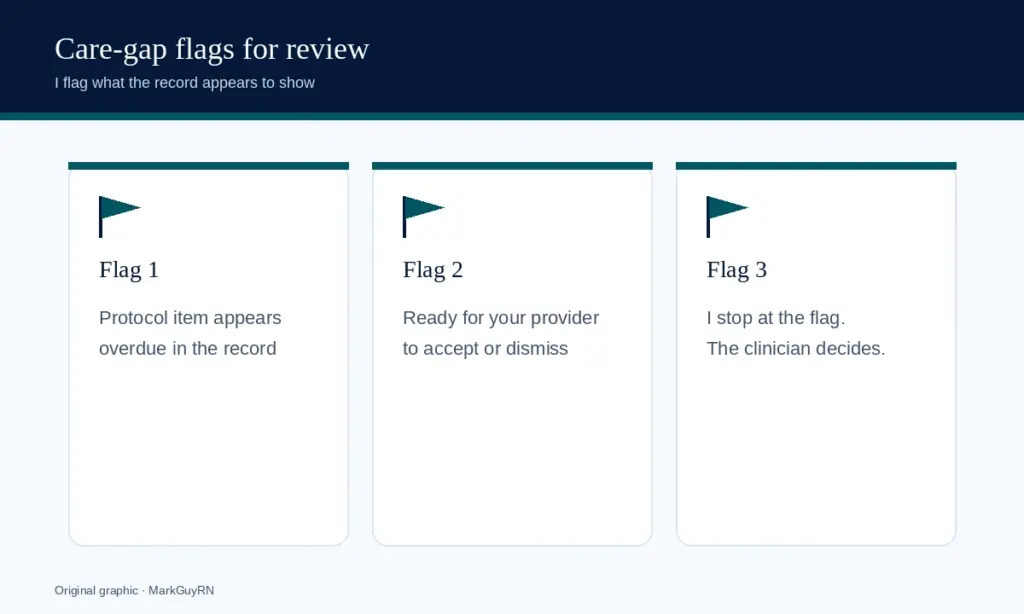
A useful flag is boring in the best way. It says, clearly, that something in the record appears overdue against your protocol. It does not say that I decided the item should be ordered, and it does not pretend the measure is already complete. Your authorized provider can accept the flag, dismiss it, or complete the work. My sentence stops at “this appears overdue in the record.”
Due-item flags based on the protocols, quality lists, or health-maintenance rules your practice provides.
Notes that distinguish “this appears overdue in the record” from “I decided it should be ordered.” The second one isn’t my sentence to write.
Flags delivered in the chart or the format we agree on, ready for your provider to accept, dismiss, or complete.
This is part of pre-visit organization, not a standalone care-management program. It often shows up beside wellness-visit checklist staging and medication list work, because paperwork likes to travel in packs.
How I Work Through the List
You tell me what to look for. I don’t invent a quality program for your practice, and I don’t arrive with a generic list I found on the internet. During visit preparation I compare the record to the rules you provided. If an item appears overdue, I flag it in the place we agreed on. If the record already shows the work, I leave it alone. The goal is a flag your provider can actually use, not a longer to-do pile with a prettier color.
That second part is as important as the first. A flag that fires on work already done is just another sticky note. I aim for a clean, reviewable signal—not a pile of noise. Even then, a flag is not care gap closure. Closing the gap, ordering a test, or calling the patient is your clinical team’s work, not mine.
We set this up the same way as the rest of the documentation support: a general business conversation, a BAA, and access your IT team controls. Details are on Accessing your EHR. Please don’t send patient lists or charts through the website.
What You Get
Example only, not real patient data. This is an obviously fictional snapshot so you can see the shape of the work—no real names, dates of birth, or medical record numbers.
Here’s a fictional snapshot for Patient A, a 6x-year-old, with a visit on the coming week’s schedule. This is not a real patient and not a real quality measure.
- Your protocol asks me to look for Item X. It is not documented in the record, so I flag it as appearing overdue.
- Item Y is already documented in a prior note, so I do not flag it.
- The flag is written as “this appears overdue in the record,” not as an order or a completed measure.
- Your provider can accept, dismiss, or complete the work. I don’t close the gap.
I plant the flag and step back. Your authorized provider reviews it and decides whether anything should happen.
What I Don’t Do After I Flag
I don’t close the gap, order the test, or run a care-coordination program. Your authorized provider reviews the flag and decides whether anything should happen. My work stops at the flag.
I don’t bill, code, or own CDI work. I don’t claim that a flag equals a completed measure.
Questions Practices Ask
Do you close the gaps yourself?
No. I flag them during visit preparation. Your provider reviews the flag and decides what happens next.
Whose protocol do you use?
Yours. I don’t invent a quality program for your practice. You tell me what to look for, and I flag what the record appears to show.
Yours. I don’t invent a quality program for your practice. You tell me what to look for, and I flag what the record appears to show.
Is this care coordination?
No. I don’t offer care coordination or chronic-care management. This is documentation support inside visit preparation.
Where does the information live?
In your authorized systems, after a BAA. Please don’t send patient lists or charts through the website.
Ready to Stop Starting the Day with a
Scavenger Hunt?
Book a free 30-minute call. Bring the name of your EHR and your best Monday-
morning fax story.
Prefer writing first? Send me a message. Business details only, please, no patient information.
