
Medical Virtual Assistant Services by a Registered Nurse
Most medical virtual assistant services hand you a generalist who juggles a little of everything and, somewhere in between, maybe opens a chart. I’m the opposite. I’m Mark, a registered nurse, and I’m a specialized chart-prep VA. Charts are my main event.
Free 30-minute call. No patient information needed.
A Calmer Chart Before
The First Patient
Clinic mornings have a soundtrack: the fax queue, a PDF named scan_final_FINAL2.pdf, and a chart that still isn’t ready at 7:58 AM. I log into your EHR ahead of clinic, work through the upcoming schedule, and get each record in order, so your provider walks into the room already knowing the story instead of reconstructing it from attachments.
You get one named person at one desk, working in the systems your practice controls. Not a rotating roster, and not a different voice every Monday.
A typical stretch of the work is quieter than it sounds. I open the visit list your practice shares, go patient by patient, and make each record behave: outside notes filed instead of left as an attachment with no bookmark, a missing result flagged the day before instead of discovered mid-visit, and a short note at the top so your provider knows what changed since the last appointment. By the time your first patient checks in, the paperwork has already had its coffee.
Visit-Ready Chart Checklist
Documentation staged for provider review
Outside records staged in the chart
Missing attachment flagged for the team
Medication list prepared for review
Visit packet in one place, not a scavenger hunt

What I Do Before The Visit
Outside records and referral packets opened, labeled and filed. More on records indexing.
Labs and imaging staged where your provider looks first, with gaps flagged.
A visit-ready medication list with mismatches flagged for review. More on medication reconciliation support.
Wellness-visit checklists and care-gap flags staged before the appointment.
A short note for the provider: what’s ready, what’s missing, what needs a look.
The full menu, including chart completeness checks and new-patient chart setup, lives on my chart prep and precharting page.
A Specialist Gets Faster On Your Charts Every Week
A lot of virtual medical assistant services are built for coverage: inbox, scheduling, a little of everything. That’s useful work. My lane is the chart.
Charts reward focus. The person who learns where your practice files a cardiology consult, which labs your protocols expect and how each provider likes a med list laid out gets quicker and more accurate every week. That’s the advantage of one nurse virtual assistant who only preps charts: nobody re-learns your system on Monday, and nothing gets lost in a hand-off.
So if you’re comparing virtual assistant healthcare options, here’s my honest pitch: I’ll have the chart ready before anyone has to go looking.

One Chart, The Night Before
Example only, not real patient data. Fictional details, no real names, dates of birth or record numbers.
Patient a, follow-up on tomorrow’s schedule (fictional).
Outside consult PDF: filed under Consults instead of the general attachments pile.
A lab result the protocol expects isn’t in the record: flagged for your team. I don’t order tests.
Medication list: prepared from the chart and the pharmacy history your practice authorizes, with one dose mismatch flagged.
One-page summary of what’s already documented, left for your provider. No new clinical conclusions.
Getting started is mostly paperwork (the good kind)
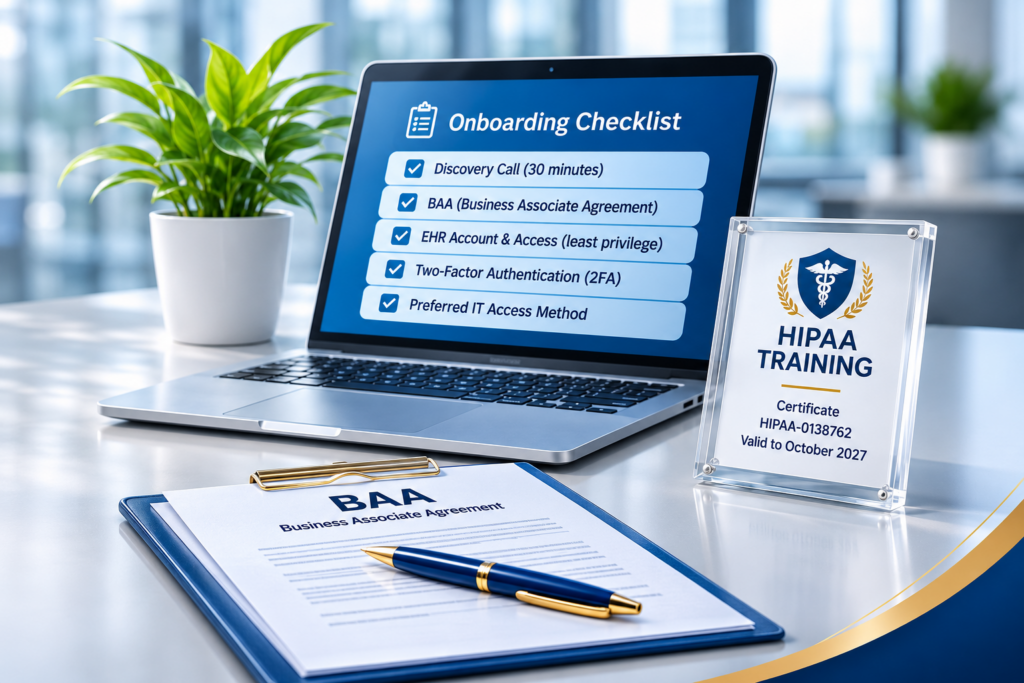
We begin with a free 30-minute call about your specialty, your EHR and what “ready” means at your practice. Then your team stays in control of access: a BAA, an account you create with the least access the work needs, your 2FA, and the method your IT team already trusts. The details are on Accessing your EHR.
I completed HIPAA training (certificate HIPAA-0138762, valid to October 2027). You can read what it covered and how I handle patient information.
What Stays With Your Team
Scheduling, billing, coding, orders, signatures and every clinical decision stay with your practice. I organize and flag. Your provider decides what the visit is about..
Questions practices ask
What does a virtual medical assistant do?
A virtual medical assistant supports a practice remotely, and the job varies by who you hire. Most medical virtual assistant services cover a little of everything. Mine covers charts: outside records filed, results staged, med lists flagged, and a short note for your provider. One lane, done carefully.
Why hire a virtual medical assistant instead of adding in-office staff?
A virtual medical assistant can take a defined chunk of paperwork off your team without another desk, chair or badge. For me that chunk is chart prep, so your MAs spend mornings with patients instead of PDFs. If you need front-desk coverage, you may need a different kind of help.
Is it safe to give a remote assistant access to our EHR?
Your practice stays in control of access. I’m HIPAA trained and certified, we sign a BAA, and your team creates a named account with the least access the work needs, protected by your two-factor setup. I work from one fixed workstation, and you can turn my access off whenever you choose.
How much does a virtual medical assistant cost?
I prefer per-chart-note pricing, and I’m open to a monthly retainer with a quota. I don’t post dollar amounts, because the right number depends on your scope. Book the free 30-minute call and I’ll quote you against what “ready” means at your practice.
Do you handle scheduling or answer phones?
My main lane is the chart, not the front desk. Phone calls can vary; sometimes it’s manageable, so we talk it through when we set the scope. What you can count on is one named person, working inside your systems, getting your charts ready before the visit.
My main lane is the chart, not the front desk. Phone calls can vary; sometimes it’s manageable, so we talk it through when we set the scope. What you can count on is one named person, working inside your systems, getting your charts ready before the visit.
Is it always the same person, and what happens when you’re out?
Yes, it’s me, the same registered nurse on every chart. If I’m out for a day or two, the work still gets done and completed. I plan ahead and keep you posted, so we stay on top of your deadlines. If it ever doesn’t get done, I issue you a prorated discount.
What hours do you work?
I work Monday to Friday, on US hours: 8 AM to 8 PM Eastern. That covers US clinic mornings, so your charts can be ready before your first patient checks in, not whenever I happen to log on.
How long does it take to get up to speed on our workflows?
Initial setup takes about three hours, then about a week to get fully accustomed to your practice’s EHR. I start with your checklist and how each provider likes a chart laid out. The more you write down, the faster it goes, so even a sticky-note process is fine.
Want a specialist on your charts?
Book a free 30-minute call. We’ll talk about your EHR, your clinic schedule and the part of the morning that keeps going sideways.
Prefer writing first? Send me a message. Business details only, please, no patient information.
